Sourcing & export note: Indonesia supplies over 80% of the world’s natural rattan raw material; we aggregate vetted producers in Cirebon, Jepara and Bali. Natural rattan (Calamus and Daemonorops spp.) is not listed under CITES, so no CITES permit is required. Roll dimensions, strand width, weave consistency and moisture (kiln-dried to a 12–16% range) vary naturally by producer and order. Prices are indicative ranges (last verified June 2026); final pricing is by quote per pattern and width. We are an independent sourcing and export desk, prepare standard export documents, and connect you to vetted Indonesian workshops — this is general information, not legal or customs advice.
Closed weave rattan webbing is a flat-woven rattan panel with no intentional holes or open pattern, producing a continuous, solid-looking surface. In furniture production, closed weave rattan webbing is used where you want the warmth of rattan but the visual privacy and surface coverage of a panel rather than an open cane mesh.
What Is Closed Weave Rattan Webbing?
Closed weave rattan webbing (sometimes called flat woven rattan webbing or solid rattan panel webbing) is woven from peeled rattan core or outer-skin strands set edge-to-edge, without the hexagonal or radio-style openings you see in classic cane chair mesh. The result is a flexible sheet that behaves like a continuous mat.
Key characteristics:
- No mesh holes: The surface appears visually “solid” from normal viewing distance.
- Flat, tight interlacing: Strands are woven in plain weave or small repeating patterns with minimal texture relief.
- Supplied in rolls: Typically 45–100 cm wide, 15 m or 50 ft long (roll length can vary by spec).
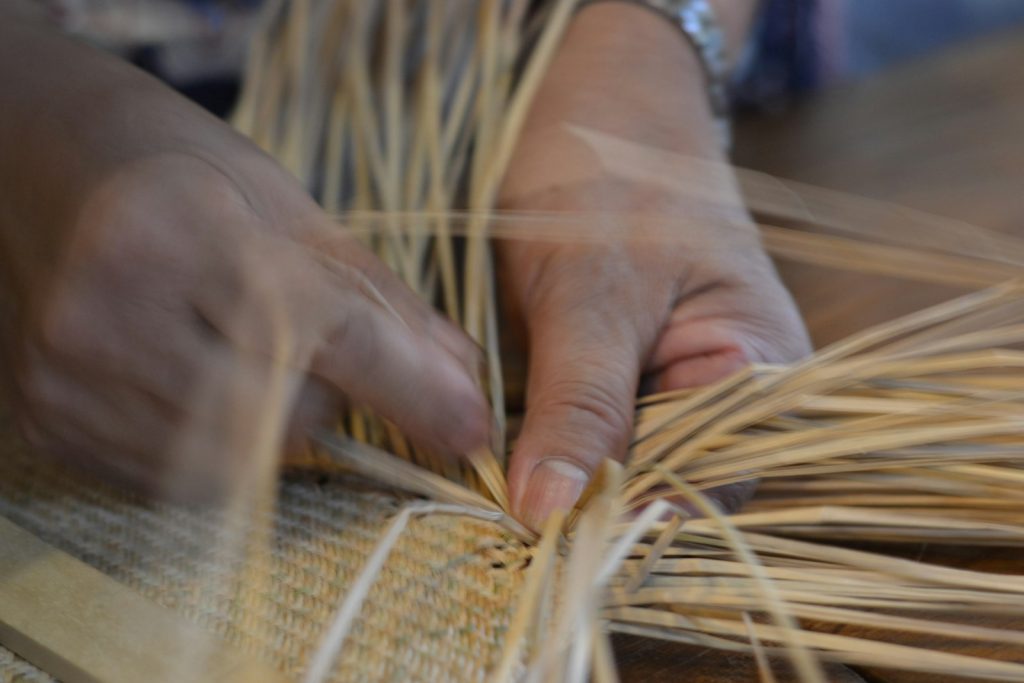
- Handwoven: Most Indonesian production remains hand or semi-hand woven, then machine-trimmed.
Because the weave is closed, this material behaves more like a thin veneer or textile than a traditional cane mesh. It is especially suited to cabinet and door panel applications where the backing substrate provides structure.
Common Uses: From Rattan Insert Cabinets to Door Panels
Closed weave rattan webbing is a workhorse material in cabinet and furniture production across Scandi, coastal, and French country collections. Main use cases:
Cabinet Door Inserts
Rattan insert cabinet fronts are the highest-volume application. Manufacturers typically:
- Build a timber or MDF frame with a recessed panel area.
- Lay the closed weave rattan webbing over a plywood or MDF backing panel.
- Adhere and trim the webbing, then apply edge beading or frame moulding.
Because the weave is closed, you get the decorative rattan surface without visual transparency into the cabinet interior. This avoids the need for perfect shelf styling, which is often a commercial concern in retail.
Rattan Door Panel Webbing
Flat woven rattan webbing is also widely used as rattan door panel webbing in:
- Wardrobe and armoire doors
- Sideboards and buffets
- Bathroom vanities (with appropriate humidity management)
- Sliding door systems and lightweight screens
In these applications, the webbing is usually laminated or adhered to a stable substrate panel. Structural performance comes from the panel and frame; the webbing provides the visual surface and tactile warmth.
Room Dividers & Headboards
For room dividers and headboards, closed weave rattan webbing is specified when designers want a calm, continuous field of natural texture:
- Room dividers: Framed panels, sometimes double-sided, with the webbing laminated on both faces of a light core.
- Headboards: Large-format panels, often with curved profiles, where webbing is tensioned and stapled or backed by plywood.
Compared with open cane, a flat, solid rattan panel webbing reduces visual noise and better suits minimalist or Scandi-influenced interiors.
Material Options: Natural vs Synthetic Closed Weave
Rattan Webbing Supplier sources both natural and synthetic closed weave specifications from Indonesian partner workshops and factories. Choice depends on environment, usage, and target market positioning.
| Attribute | Natural Closed Weave Rattan | Synthetic Closed Weave (PE/PP) |
|---|---|---|
| Base material | Natural rattan (skin or core) | Extruded polyethylene / polypropylene |
| Visual character | Natural colour variation, growth marks, occasional specks | Highly uniform colour and surface |
| Moisture sensitivity | Expands/contracts with humidity; needs controlled conditions | Dimensionally more stable; suitable for higher humidity |
| Outdoor suitability | Not recommended for full exposure | Outdoor grades available (UV-stabilised) |
| Feel & warmth | Natural warmth, slight fibre “life” under hand | Smoother, more engineered feel |
| Repair & ageing | Ages organically; patina over time | Colour holds longer; ageing is more uniform but less “organic” |
Natural Closed Weave Rattan Webbing
Our natural closed weave lines are woven from moisture-conditioned rattan split or peel. Standard production is based on moisture content in the 12–16% range at packing, consistent with Indonesian export norms for kiln-dried rattan products.
Visual characteristics include:
- Slight shade variation within and between rolls.
- Occasional darker growth lines and pin-sized “eye” marks.
- Minor strand width variation due to hand-splitting and hand weaving.
These features are natural attributes of handwoven rattan, not defects. For brands whose clients expect a perfectly uniform, plastic-like surface, synthetic may be more appropriate.
Synthetic Flat Woven Rattan Webbing
Synthetic closed weave webbing is typically specified for:
- High-humidity or coastal projects.
- Applications near wet areas (bathrooms, covered outdoor dining).
- Large-volume retail programs demanding very tight colour tolerances across containers.
We work with factories extruding PE/PP strands in calibrated widths, then weaving flat sheets and heat-setting for dimensional stability. Colour and texture libraries typically include naturals (light, honey, walnut) and solid design colours (black, white, greys). Fire performance requirements can be discussed at RFQ stage.
Weave Structures: How “Closed” Is Closed?
Within closed weave rattan webbing, there are still different internal structures, which influence appearance, flexibility, and finishing behaviour.
Plain Flat Weave
The most common solid rattan panel webbing is a simple plain weave:
- Warp and weft strands alternate over-under in a 1×1 pattern.
- Strands are set very close together so the overall surface reads as continuous.
- Texture is subtle; suitable for minimalistic and Scandi-influenced furniture lines.
Fine Herringbone / Chevron Variants
Some collections specify a fine herringbone or chevron variation in closed weave to provide more visual movement without opening gaps. These patterns:
- Remain essentially “closed” (no through-holes) but show small diagonal direction changes.
- Can mask small handling marks better than completely linear plain weave.
- Work well on wardrobe doors and headboards where the panel area is large.
Backed vs Unbacked Webbing
By default, closed weave rattan webbing is supplied unbacked (no fabric or paper backing). Some OEMs apply:
- Non-woven backing for easier lamination on MDF or plywood.
- Thin foam or felt layer where acoustic dampening is desired (e.g., office partitions).
If you plan to machine-press or membrane-press the webbing onto substrates, discuss backing and adhesive compatibility during specification.
Standard Roll Specs: Widths, Lengths & Thickness
As an export desk, we consolidate production from multiple weaving partners. The typical standard specs available for closed weave rattan webbing are:
- Roll widths
- Approx. 45 cm, 60 cm, 90 cm, and 100 cm. Other widths by special order, subject to MOQ and lead time.
- Roll length
- Commonly 15 m per roll (slight variation per workshop). Master rolls up to ~50 m may be available in synthetic lines.
- Strand width
- Typical natural strand widths 3–7 mm. Narrower strands give finer visual grain; wider strands appear “bolder” and slightly more rustic.
- Approx. thickness
- Natural closed weave: typically around 1.5–2.0 mm in the flat field, excluding any finishing lacquer. Synthetic: similar thickness, slightly more uniform.
We recommend that cabinet and door manufacturers allow for ±3–5% tolerance on roll length and small variances in usable width after edge trimming, especially for natural handwoven material.
Finish Options: Natural, Pre-Lacquered, and Custom
Closed weave rattan webbing can be finished at the weaving facility or at your own plant. The main options:
Unfinished / Natural
Unfinished natural webbing is shipped sanded but otherwise raw. Advantages:
- Maximum flexibility to match your own stain and lacquer system.
- Better adhesion if you will be pressing or bonding to substrate first, then finishing the entire cabinet as one system.
- Lower initial cost per roll.
Raw natural rattan will darken slightly over time, especially in UV-exposed locations, and may show more tonal evolution than pre-lacquered material.
Clear Lacquered
Factory-applied clear lacquer provides:
- Basic surface protection against handling and minor splashes.
- More stable initial colour out of the box.
- Time savings for OEMs who assemble but do not run finishing lines.
Lacquer systems are typically PU or NC-based, applied in one or two coats. For export programs, we can discuss VOC and compliance targets during RFQ. Note that heavy lacquer can reduce flexibility; for tight-radius applications, lighter coats or in-house finishing after forming may be safer.
Toned / Stained Finishes
For branded furniture programs, common tones specified include:
- Light natural (nearly raw appearance, slightly sealed)
- Warm honey / medium oak tone
- Smoked or walnut-brown
- Black or deep espresso
Colour targets are best communicated using physical samples or cross-referenced against widely used stain charts. Allow for small batch-to-batch variation, especially with natural rattan, as substrate colour shifts will affect final tone.
Natural Variation vs Defects in Closed Weave Rattan
One of the most frequent topics in B2B procurement calls is how to distinguish natural character in handwoven rattan from actual defects. Setting realistic expectations internally and with your retail buyers reduces claim rates and rework.
What Counts as Natural Variation
The following characteristics are normal for natural closed weave rattan webbing within our QC limits:
- Colour variation: Light-to-medium shading differences between strands and across the roll.
- Growth marks: Fine lines, specks, and occasional “eyes” that reflect the plant’s growth.
- Minor strand width fluctuation: Small changes in strand width and slightly imperfect edges due to hand-splitting.
- Subtle weave undulation: Very mild waviness that resolves when tensioned over a substrate.
These do not impact function and are inherent to the material. Many brands treat them as part of the aesthetic story for natural rattan furniture.
What Our QC Flags as Defects
During pre-shipment inspection, our QC teams flag and reject or downgrade rolls with:
- Broken or missing strands leaving visible gaps.
- Large stains or oil marks that cannot be sanded or finished out.
- Severe weave distortion that cannot be corrected by normal stretching.
- Mould growth or active insect activity.
- Excessive brittle strands indicating over-drying or poor processing.
Defect thresholds and sampling plans are specified in the purchase contract. We can align to buyer-side AQL protocols for volume programs.
Working With Closed Weave Rattan in Production
Proper handling from goods-in through assembly is critical to minimise scrap and warranty issues.
Acclimatisation & Storage
- Store rolls flat or standing on end in a dry, ventilated area.
- Avoid direct floor contact; use pallets or racks.
- Allow 48–72 hours of acclimatisation in the production environment before cutting, especially for climate shifts from Indonesia to temperate markets.
Cutting & Forming
- Use sharp knives or shears; dull blades crush fibres and cause fraying.
- Plan layout to minimise visible seams on large doors; where seams are unavoidable, place them behind rails or decorative mouldings.
- For curved headboards or door fronts, pre-form the webbing over templates before final fixing to reduce stress marks.
Bonding & Fastening
Common methods for turning closed weave rattan webbing into a functional panel:
- Lamination: Adhesive bonding to a plywood/MDF core followed by trimming; suitable for CNC machining after cure.
- Stapling/tacking: Webbing stretched over a frame or panel and secured on the back with staples; typical in headboard construction.
- Membrane pressing: For some synthetic variants and certain finishes, press lines can form 3D profiles; confirm material compatibility first.
Finishing Considerations
- Test your stains/lacquers on offcuts from the specific batch shipped; natural variation affects take-up.
- Avoid very heavy build coats on free-spanning areas; keep film flexible.
- Allow full cure before wrapping and shipping finished furniture to avoid blocking or imprint marks.
If you’re evaluating rattan for a new furniture line and need to understand how it will behave in your specific process, you can request sample rolls and then plan your trip to visit weaving and finishing partners in Indonesia for joint trials. We can coordinate video or WhatsApp-based process reviews as well.
Design Trends: Scandi and French Country Collections
Closed weave rattan webbing has found a strong position in several current design languages:
- Scandi / Japandi: Light-toned, flat-woven panels combined with clean oak or ash frames and minimal hardware.
- French country / Provence: Warm, mid-tone webbing framed by painted timber; used for buffets, hutches, and wardrobes.
- Modern coastal: Light honey webbing paired with white or sand-coloured frames for sideboards and media units.
Because closed weave reads calmer than open cane, it works well on large continuous surfaces such as wardrobe banks and wall-mounted storage. Many brands use a mix: closed weave for main doors and drawers, with selective use of open cane in feature panels or accent pieces.
MOQ, Lead Times & Export Terms
As an independent sourcing and export desk, we coordinate capacity across several Indonesian weaving and finishing partners. The figures below are broad ranges based on current patterns; specific numbers will be confirmed at RFQ stage and may shift with demand cycles.
Minimum Order Quantities
- Natural closed weave (standard widths, natural/clear): MOQs often start around 10–20 rolls per spec for consolidated shipments.
- Pre-lacquered or custom tones: Higher MOQs per colour are typical, to amortise finishing setup; plan for 20–50 rolls per colour/spec depending on partner.
- Synthetic closed weave: For stock colours, MOQs can be similar to natural. Custom colours and patterns frequently require larger MOQs tied to extrusion batch sizes.
Lead Time Expectations
Indicative production lead times for closed weave rattan webbing are commonly in the range of:
- 4–8 weeks for standard natural webbing once PO and deposit are received.
- 6–10 weeks for pre-lacquered or custom-tone runs, depending on finishing capacity and drying conditions.
- Additional time should be allowed for consolidation, fumigation (if required), export clearance, and sea transit to your port.
Lead time buffers are especially important for seasonal program launches and containerised shipments aligned to retail windows.
Incoterms & Documentation
Most of our trade is done on FOB Indonesian ports (e.g., FOB Semarang, FOB Surabaya) with the buyer nominating the freight forwarder. For specific buyers and projects, other terms (such as CFR or CIF) can be discussed, but FOB gives most furniture manufacturers best control over downstream logistics.
Typical documentation set includes:
- Commercial invoice and packing list.
- Bill of lading.
- Certificate of origin (as applicable for your market).
- Fumigation certificate or phytosanitary documentation for natural rattan, if required by destination.
Indicative Pricing Ranges (FOB, Last Verified June 2026)
Closed weave rattan webbing pricing depends on width, weave density, finish, and order volume. Below ranges are indicative only and will be refined at quotation stage:
- Natural, unfinished closed weave: Typically priced per roll or per metre; lower end for narrower widths and higher for 90–100 cm widths and finer weaves.
- Pre-lacquered / stained natural: Premium over raw webbing reflecting finishing labour and materials.
- Synthetic closed weave: Similar to or above mid-range natural webbing depending on polymer grade, UV treatment, and colour.
Because polymer and freight inputs are volatile, we treat all pricing as valid for a defined quotation window only. Share your target spec, yearly volume estimate, and preferred Incoterm and we’ll respond with current workable options for your program.
Comparing Closed Weave With Other Rattan Webbing Types
Many buyers source multiple patterns—closed weave for solid surfaces, open hexagonal for ventilated panels, and decorative patterns for accents. Summary comparison:
| Pattern Type | Visual Effect | Privacy | Typical Uses |
|---|---|---|---|
| Closed weave rattan webbing | Flat, continuous texture | High (no through-holes) | Cabinet inserts, wardrobe doors, room dividers, headboards |
| Open hexagonal cane | Classic “café chair” mesh | Low–medium | Chair seats/backs, light cabinet doors, radiator covers |
| Radio / diamond patterns | Decorative geometric mesh | Low–medium | Feature panels, accent doors, hospitality fit-out |
| Herringbone open weave | Diagonal visual movement | Medium (more coverage than hexagonal) | Accent cabinet fronts, screens, wall panels |
For brands consolidating SKUs, using one or two base colours across both closed and open patterns simplifies finishing and storytelling while still giving variety in texture and privacy.
How We Work With Buyers
Rattan Webbing Supplier operates as an independent Indonesian sourcing and export desk, coordinating between rattan weaving workshops, finishing facilities, and international buyers. Our role is to translate design and procurement requirements into workable, repeatable specifications on the ground.
From Spec to Shipment
- Specification phase: You share reference images, drawings, or existing samples. We clarify required widths, weave density, colour/finish, target landed cost, and yearly volume.
- Sampling: We arrange lab-dip style colour samples and small cut or roll samples of candidate weaves.
- Trial production: For larger programs, a pilot batch is run and inspected against agreed QC protocols.
- Ongoing orders: Once approved, repeat orders run on standard lead times with periodic QC reviews.
Quality Control & Communication
- On-site inspection and photo/video reporting at key stages.
- Clear documentation of accepted natural variation vs reject criteria.
- WhatsApp and email channels for day-to-day updates; scheduled calls for program reviews.
If you are planning a sourcing trip to Indonesia to qualify multiple rattan and furniture components, you can plan your trip with our team; we are used to coordinating plant visits and can stay in touch via WhatsApp while you review samples and production.
Next Steps: Specifying Closed Weave Rattan Webbing for Your Line
To move from interest to a workable sourcing plan, you will need at minimum:
- Target roll width(s) and approximate yearly roll consumption.
- Natural vs synthetic preference (or willingness to evaluate both).
- Desired finish: raw, clear lacquer, or stained/coloured.
- Usage context (indoor only, covered outdoor, high-humidity areas, etc.).
- Any specific test standards applicable in your market.
From there, we can propose available patterns and finish options that match your technical and cost requirements, then arrange sampling and quotations under your preferred Incoterms.
To begin, share your specifications and program timelines, and we’ll respond with options, lead time projections, and sample availability. You can plan your trip or a remote sourcing process with us; WhatsApp-based communication is standard, especially during sampling and pre-shipment QC.
FAQs: Closed Weave Rattan Webbing
Is closed weave rattan webbing fully opaque?
From normal viewing distance, closed weave rattan webbing reads as visually solid and provides privacy comparable to a thin panel. At very close range, microscopic pinholes or pores may be visible between strands, especially before finishing, but these do not meaningfully affect privacy in cabinet and door applications.
Can I use natural closed weave rattan webbing in bathrooms or near kitchens?
Natural webbing can be used in well-ventilated indoor spaces with normal residential humidity, but constant high humidity, steam, or direct water exposure will shorten its life and may cause warping or mould if the surrounding construction traps moisture. For heavy-use bathrooms or coastal projects, many buyers prefer synthetic closed weave or design the cabinet so the rattan is set back from direct splash zones.
How do I explain natural variation to my retail buyers?
The simplest approach is to standardise internal language: rattan is a natural fibre, so small shade differences, growth marks, and minor weave irregularities are normal and part of the material’s character. Reserve “defect” language for structural issues such as broken strands, large stains, or severe distortion. Including close-up photos in product pages and training materials helps align expectations.
Can closed weave rattan webbing be CNC-routed after lamination?
Yes. Many factories laminate closed weave onto MDF or plywood and then CNC-cut door and drawer fronts. Use sharp tools, ensure the adhesive bond is fully cured, and test on trial panels to tune feeds/speeds so you avoid tearing at the webbing edge. Sealing cut edges after machining improves durability.
What information do you need to quote closed weave rattan webbing?
To quote efficiently, we need: desired material (natural or synthetic), roll width, approximate yearly quantity, finish (raw or lacquered/coloured), target application (cabinet doors, wardrobes, etc.), destination port, and preferred Incoterm (commonly FOB). With that, we can suggest specific weaves and provide indicative FOB pricing and lead times.