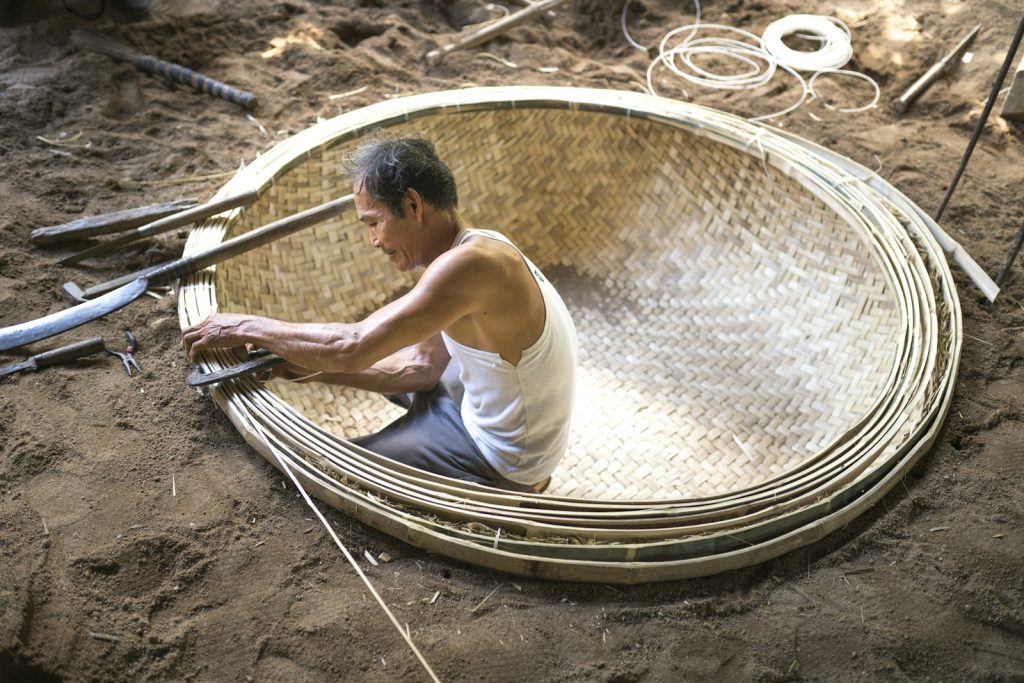
Sourcing & export note: Indonesia supplies over 80% of the world’s natural rattan raw material; we aggregate vetted producers in Cirebon, Jepara and Bali. Natural rattan (Calamus and Daemonorops spp.) is not listed under CITES, so no CITES permit is required. Roll dimensions, strand width, weave consistency and moisture (kiln-dried to a 12–16% range) vary naturally by producer and order. Prices are indicative ranges (last verified June 2026); final pricing is by quote per pattern and width. We are an independent sourcing and export desk, prepare standard export documents, and connect you to vetted Indonesian workshops — this is general information, not legal or customs advice.
Radio weave rattan is a niche cane webbing pattern where strands radiate outwards in multiple directions to form a geometric star or “radio” motif. In this guide we explain how radio weave rattan is constructed, where it’s used, and what furniture makers and buyers must know about roll specs, MOQ, QC, and export terms before placing a production order.
What Is Radio Weave Rattan Webbing?
Radio weave rattan webbing (often called radio pattern cane, radial rattan weave, or star pattern rattan webbing) is a hand-woven panel made from peeled rattan core strands arranged in radiating lines. Instead of a simple grid or hexagon, the strands intersect at varying angles to create a repeating star motif.
In trade terms, “radio” or “radial” is a pattern description, not a species or grade. The base material is usually:
- Natural rattan peel/core (Calamus spp.) for traditional cane furniture and décor.
- Synthetic rattan (PE/HDPE with UV stabiliser) for outdoor or high-humidity applications.
Because the star pattern requires more directional changes and tighter intersections than open or hexagonal weave, radio weave panels are slower to produce, have more artisan input, and are priced accordingly at a premium level.
Key Characteristics of Radio / Star Pattern Rattan Webbing
Visual Pattern and Geometry
Radio weave is defined by its distinctive star-shaped cells:
- Multiple strands radiate from a conceptual centre point, forming a star or “sunburst” motif.
- Intersection angles are not limited to 90° or 60°; you’ll see mixed angles within each repeating unit.
- Negative space is more decorative than purely functional; it reads as a pattern, not just ventilation holes.
The pattern sits between open and semi-closed visually. It still allows some light transmission, but the star motif becomes the primary design element. For this reason, radio weave rattan is usually used in feature panels rather than full chair seats that need maximum airflow.
Strand Width and Gauge
In Indonesia, radio pattern cane is typically woven from narrow to medium-width strands, for example:
- Natural rattan peel: approx. 2.0–3.0 mm visible width per strand.
- Synthetic PE rattan: approx. 2.5–3.5 mm visible width per strand.
Narrower strands allow sharper turns and better definition of the star tips. Wider strands can be used for bolder, more graphic patterns but require more precise tension control to avoid buckling.
Open vs Semi-Closed Effect
Radio weave is functionally semi-open:
- More material coverage than standard ½” open hexagonal chair cane.
- Less coverage than fully closed basket weave or herringbone webbing.
As a result, radio weave rattan is frequently specified for accent panels where the design should read clearly at a distance: headboard inserts, cabinet door fronts, mirror surrounds, or statement backrests.
Applications: Where Radio / Star Weave Performs Best
Accent and Statement Furniture
Radio weave is rarely used across an entire collection; it’s chosen to elevate a few hero pieces. Typical applications include:
- Headboards and bed ends: Star pattern rattan webbing as a central inset framed by solid wood.
- Chair and bench backs: Visual focus on the backrest rather than the seat for both comfort and aesthetics.
- Cabinet and wardrobe doors: Radial rattan weave adds pattern without feeling too busy across a large surface.
- Table and sideboard fronts: Drawer or door fronts in radio pattern cane paired with timber or metal frames.
Décor and Interior Detailing
The ornamental nature of radio pattern cane lends itself well to smaller, high-margin décor products:
- Mirror frames and wall panels with star weave as a decorative band.
- Room dividers and screens where the pattern reads clearly as a repeating motif.
- Lighting shades (pendant or table lamps) in synthetic radio weave for better shape retention.
Because the pattern is visually strong, buyers usually specify it for one or two key elements in a room, then support it with simpler open or closed patterns elsewhere.
Retail Positioning
From a merchandising angle, radio weave panels typically:
- Sit in a premium price tier within a rattan or cane line-up.
- Are used on SKUs marketed as “statement”, “feature”, or “collector” pieces.
- Generate higher perceived value per square metre of cane surface compared to simple open weave.
For brands, this pattern can justify higher ticket prices with relatively modest extra material cost; the main cost driver is labour and slower weaving time.
Natural Radio Weave vs Synthetic Radial Cane
Both natural and synthetic versions of radio weave rattan are available from Indonesian producers. The choice depends on end-use conditions and brand positioning.
| Aspect | Natural Radio Weave Rattan | Synthetic Radio Weave (PE/HDPE) |
|---|---|---|
| Base Material | Peeled rattan core (Calamus spp.) | Extruded PE/HDPE with UV stabiliser |
| Typical Use | Indoor furniture, covered terraces | Outdoor, high humidity, contract/hospitality |
| Moisture Sensitivity | Needs controlled humidity, can expand/shrink | Dimensional stability in damp or sun-exposed areas |
| Surface Feel | Warm, organic, slight fibre variation | Smoother, more uniform, “engineered” look |
| Colour Range | Natural honey through to stained/toned finishes | Wide RAL-like palette incl. solid colours and faux-natural tones |
| Pattern Crispness | Small variations in star size and angle are normal | More uniform star size, tighter tolerance in repeating units |
| Cost Position (per m²) | Mid to high, labour intensive | Mid to high, tool and extrusion cost spread over volume |
| Repair / Re-caning | Traditional craft methods, local recaning feasible | Requires matching synthetic profile and colour |
Technical Specs: Radio Weave Rattan Webbing Rolls
Because radio/star patterns are less standardised than open hexagonal cane, producers often work to project-specific specs. Typical parameters we help buyers define include:
Roll Widths
Indonesia’s handwoven radio webbing is commonly produced in:
- 45–50 cm roll width for chair and bench backs, smaller cabinet fronts.
- 60–70 cm for headboards and wardrobe doors.
- Up to around 90 cm for large-format panels, subject to weaver capacity and quality tolerance.
For very large surfaces, we usually recommend breaking the surface into framed sections rather than requesting extra-wide single panels, as pattern distortion risk increases with width.
Roll Lengths
Standard roll lengths for specialty patterns are usually shorter than common open-weave chair cane. Expect:
- 5–15 m per roll for natural radio weave, depending on strand width and pattern repeat.
- Synthetics can be run longer, but shipping and handling of very long rolls can become impractical.
When you brief us, please estimate your required net square metres and include a reasonable wastage factor (often 10–15% for complex patterns) so we can advise suitable roll counts.
Pattern Repeat and Tolerances
The star motif has a measurable repeat in both warp and weft directions. In handwoven natural radio weave:
- Minor variation in star size (e.g., ±2–3 mm within a panel) is common and accepted as part of the handcraft character.
- Perfectly straight “rows” of stars are not realistic over long distances; slight drift can occur.
For synthetic radial rattan weave, pattern uniformity is higher, but some tolerance is still needed due to manual handling and framing.
Moisture Content (Natural Rattan)
For export, natural rattan webbing should be supplied at controlled moisture content to reduce mould and dimensional movement risks in transit and at destination. In Indonesia, export-oriented producers typically aim for:
- Approximately 12–16% moisture content at packing, with adequate drying and storage conditions.
Your internal quality system may specify a narrower range; share those parameters early so we can match you with appropriate weaving and finishing partners and confirm QC protocols.
Finish Options for Radio Pattern Cane
Unfinished / Natural
Most buyers of natural radio weave rattan request panels in an unfinished, light natural state. This allows:
- Colour matching to frame timber at the furniture factory.
- Use of the same lacquer, stain, or oil system as the rest of the product.
- Easier repair or partial replacement if panels are damaged post-assembly.
Pre-Finished (Natural Rattan)
Where pre-finished material is requested, common options include:
- Clear sealer to stabilise and slightly deepen the natural honey tone.
- Light to medium stains for walnut, teak, or espresso colourways.
- Topcoat systems (NC, PU, water-based) depending on your factory process compatibility.
Be aware that pre-finished radio weave is less forgiving during stretching and stapling; aggressive installation can cause surface micro-cracking in the finish.
Synthetic Colour and Surface Options
For synthetic radio weave rattan:
- Colour is set during extrusion; options range from natural-like beiges and browns to charcoal, black, and custom brand tones.
- Surface texture can be smooth or embossed to simulate rattan grain.
Minimum order quantities for custom colours are higher due to extrusion set-up, so we discuss these projects on a case-by-case basis.
Natural Variation vs Defects in Handwoven Radio Weave
Handwoven natural rattan webbing is not uniform like a printed fabric. Understanding the difference between acceptable variation and real defects helps avoid disputes and rework.
Expected Natural Variations
Within a compliant batch of natural radio weave rattan, you should expect:
- Slight colour variation between strands and across the roll (sap vs core, different vine lots).
- Minor changes in star dimension where radius or intersection angle varies slightly.
- Occasional pin knots or specks inherent to the rattan material.
- Very small surface fibres that may stand proud and can be lightly sanded before finishing.
These characteristics are part of the value proposition of natural rattan; they distinguish it from synthetic alternatives.
Defects That Should Be Controlled
Issues that should be flagged and controlled in QC for both natural and synthetic radio weave include:
- Broken or missing strands within the star pattern.
- Severe misalignment where pattern drift is clearly visible across a panel.
- Dark mould spots or off-odours indicating poor drying or storage.
- Over-brittle strands that crack under normal stretching during assembly.
Our export desk can implement agreed AQL levels, sampling plans, and photographic approval processes so that “variation” and “defect” are defined the same way by buyer, weaver, and consolidator.
MOQ, Lead Times, and Incoterms for Radio Weave Rattan
MOQ and Pattern Availability
Radio/star patterns are not “commodity” webbing. Availability and MOQ depend on whether you are:
- Ordering an established pattern already running with Indonesian weavers.
- Developing a custom star design (different repeat, cell size, or integrated border motif).
As a guide:
- Standard-like radio patterns: Practical MOQ is usually discussed at the roll lot or container component level, often aligning with a mixed-container of multiple cane patterns for efficiency.
- Custom designs: Expect a higher functional MOQ to justify sampling, pattern development, and loom set-up time. Many weavers will look for a project-based commitment (e.g., linked to your first furniture order quantity) rather than a single small trial roll.
If you have a forecast or collection roadmap, share it. That significantly improves our ability to negotiate sustainable MOQs and reserve capacity with the right weaving partners.
Lead Times
Radio weave production is slower per square metre than standard open or closed cane. Typical timing components include:
- Sampling & approvals: Allow time for initial hand samples, lab tests (if required), and finish matching.
- Weaving lead time: Dependent on order volume, strand width, and pattern complexity.
- Drying, finishing (if any), and packing: Ensuring moisture and QC parameters are met before export.
For realistic planning, most commercial buyers should assume multi-week lead times from final spec sign-off to readiness for shipment, then add ocean transit time from Indonesia to destination. We can provide current indicative timelines based on the specific port pair and season.
Incoterms and Shipment Modes
As an independent Indonesian rattan webbing sourcing and export desk, we support common trade structures including:
- FOB Indonesian port (e.g., FOB Semarang, FOB Surabaya) where you nominate your freight forwarder.
- Ex-works from the consolidator or finishing facility if you prefer full control of inland and export logistics.
We routinely consolidate radio weave rattan with other cane webbing types in mixed containers for furniture and décor customers. To discuss project-specific Incoterms and consolidation options, please plan your trip with us via email or WhatsApp; we can align lead times and loading plans to your production calendar.
Quality Control and Documentation
QC Process for Radio Weave Rattan
For export-oriented B2B orders, we can coordinate QC that includes:
- Visual inspection for pattern consistency, strand integrity, and visible defects.
- Dimensional checks on roll width, length, and pattern repeat.
- Moisture measurements for natural rattan webbing before packing.
- Sampling plans aligned to your internal AQL level and documentation needs.
For synthetic radial rattan, colour consistency, UV stabiliser specifications, and base resin documentation can be included where required by your compliance team.
Export Documentation
As a sourcing and export desk, we work with producers and logistics partners to assemble a complete document set suitable for commercial import, typically including:
- Commercial invoice and packing list aligned with HS classification for rattan/synthetic webbing.
- Certificate of origin where applicable.
- Any agreed test reports or quality certificates issued by third-party labs, if commissioned by the buyer.
If your market requires specific documentation (for example, treated-wood declarations for frames shipped alongside webbing, or formaldehyde/VOC information for finishing systems used on pre-finished panels), please specify these requirements in your RFQ so they can be built into the export flow.
Cost Position and Budgeting (Indicative)
Because raw material prices, labour rates, and freight costs adjust over time, it is not responsible to quote fixed prices here. Instead, we outline typical relative cost drivers for radio weave rattan:
- Pattern complexity: More intricate star repeats and smaller cells increase labour hours per m².
- Strand width and quality: Narrow, high-grade rattan peel can be more expensive and generates more waste in processing.
- Finishing: Unfinished natural cane is less costly than pre-finished or colour-matched synthetic variants.
- Order volume and consolidation: Larger, consolidated orders can reduce per-unit logistics costs.
FOB pricing for radio weave sits above basic open hexagonal chair cane and in a similar or slightly higher band than other decorative patterns like complex herringbone. For current indicative ranges (last verified June 2026) aligned with your required spec and volume, please request a formal quotation.
Working With an Independent Rattan Star Weave Supplier
Rattan Webbing Supplier operates as an independent Indonesian sourcing and export desk for both natural and synthetic radio weave rattan webbing. We do not own a single factory; instead we:
- Maintain a network of weaving workshops and finishing facilities across Indonesia.
- Match buyers to the right pattern capability, capacity, and quality level for each project.
- Coordinate QC and documentation so that your procurement team deals with one point of contact instead of multiple small workshops.
For some buyers, we also align webbing supply with downstream furniture assembly in Indonesia, so that radio pattern cane is integrated into finished products before export. This can be logistically more efficient than importing rolls and assembling in your own market, depending on wage levels and skill availability.
If you’re scoping a collection or a specific project and want to understand practical options for star pattern rattan webbing, you can plan your trip with us via WhatsApp or email for structured, materials-focused input rather than sales talk.
How to Brief a Radio Weave Rattan Project
To obtain an accurate quote and realistic lead time, your initial brief should cover:
- Pattern reference: Existing sample, technical drawing, or clear photo with dimensions of the star cell.
- Material choice: Natural vs synthetic, and any specific species or resin requirements.
- Strand width: Target visual width or at least a photo reference indicating fineness.
- Roll dimensions: Preferred width and minimum useful length per roll.
- Finish: Unfinished, pre-sealed, stained, or specific tone for synthetic.
- End-use and market: Indoor/outdoor, residential/contract, main destination country.
- Target timeline: Desired ex-factory or FOB date and shipping window.
The more technical and concrete the brief, the faster we can move from approximate ranges to a firm offer and trial production plan.
FAQs: Radio / Star Pattern Rattan Webbing
Can radio weave rattan be used for chair seats?
Yes, but most buyers prefer it for backrests and accent panels. The star pattern is semi-open, so it’s less ventilated than traditional open hexagonal chair cane. For high-use seating, consider using radio weave on the back and a more standard open pattern on the seat for comfort and serviceability.
Is synthetic radial rattan suitable for full outdoor exposure?
Synthetic radio weave made from UV-stabilised PE/HDPE is generally more suitable for outdoor and high-humidity conditions than natural rattan. However, overall durability also depends on the frame material, fastening method, and the specific climate. We can share typical performance expectations and material data sheets as part of a project discussion.
How much extra should I allow for wastage with star pattern rattan?
For complex patterns like radio weave, a 10–15% wastage allowance is common, especially where panels must be centred or mirrored visually. The exact figure depends on your cutting layout, framing method, and how much pattern matching your design requires.
Can the radio pattern size be customised?
Yes. The diameter of the star motif and the density of the pattern can be adjusted, within practical limits, by changing the strand count and angles. Custom designs require sampling and usually a higher MOQ, but they allow you to align the scale of the pattern with your product dimensions and brand aesthetic.
How do I get a formal quote for radio weave rattan webbing?
Send us your project brief with pattern reference, material choice, roll dimensions, estimated volume, and target Incoterm. We will respond with clarifying questions if needed and then provide an indicative FOB range (last verified June 2026) and lead-time estimate. To start that process, please plan your trip with us via email or WhatsApp so we can align on technical details from the outset.