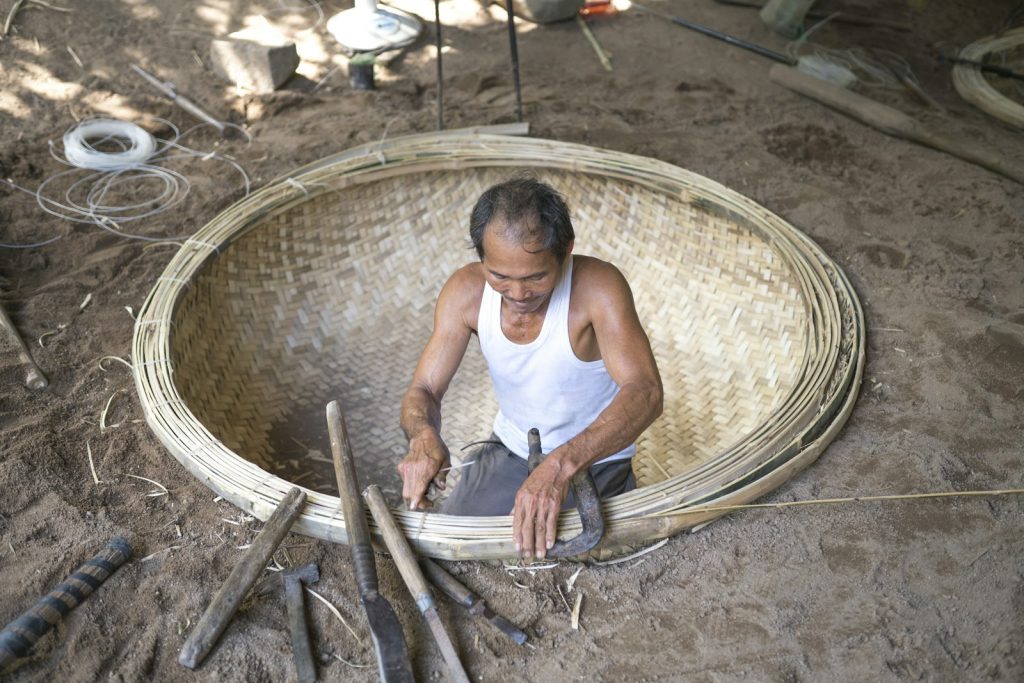
Sourcing & export note: Indonesia supplies over 80% of the world’s natural rattan raw material; we aggregate vetted producers in Cirebon, Jepara and Bali. Natural rattan (Calamus and Daemonorops spp.) is not listed under CITES, so no CITES permit is required. Roll dimensions, strand width, weave consistency and moisture (kiln-dried to a 12–16% range) vary naturally by producer and order. Prices are indicative ranges (last verified June 2026); final pricing is by quote per pattern and width. We are an independent sourcing and export desk, prepare standard export documents, and connect you to vetted Indonesian workshops — this is general information, not legal or customs advice.
Rattan webbing wholesale means buying cane and synthetic rattan webbing in roll quantities directly from source for manufacturing, retail or projects, under trade terms and MOQs. On this page I explain how we structure rattan roll wholesale orders from Indonesia: specifications, minimums, lead times, price ranges and export documentation.
I’m Bayu Kusuma, Head of Webbing Sourcing & Export at Rattan Webbing Supplier. My desk sources natural and synthetic rattan webbing from Cirebon (West Java) and Bali, consolidates orders, runs basic QC and moisture checks, and arranges export out of Indonesia on FOB or CIF terms.
If you want to buy rattan webbing in bulk, my job is to give you realistic options by pattern, width and volume – not promises that local ateliers cannot meet.
—
What We Mean by “Rattan Webbing Wholesale”
In our context, wholesale means:
- Roll-based trade (not cut-to-size panels)
- MOQ in rolls per SKU, not “by meter” retail
- Export-ready documentation and packing
- Pricing quoted on Incoterms (FOB or CIF) from Indonesian ports
You can treat us as an independent Indonesian wholesale rattan supplier and export desk. We do not run a factory; we coordinate multiple weaving ateliers in Cirebon and a few synthetic extruders on Java, then consolidate in export-ready lots.
We supply:
- Natural cane webbing bulk – open, close and decorative weaves, mostly from Indonesian rattan (Calamus spp.)
- Synthetic rattan webbing – PE/PP-based flat and hollow core, UV-stabilised for outdoor applications
—
Typical Wholesale Orders: From 5 Rolls to Full Containers
Wholesale buyers tend to fall into three bands. These are not strict categories, but they help to frame MOQ and price expectations.
1. Small Trade Orders (5–20 Rolls per SKU)
Who this fits:
- Upholstery shops and chair repair workshops
- Small furniture makers testing new ranges
- Retailers topping up popular SKUs between big shipments
Typical structure:
- MOQ: 5–10 rolls per SKU (pattern + width + material)
- Total volume: 10–60 rolls mixed across catalog items
- Service: Consolidated LCL (less-than-container load) shipment
You use our existing weaving catalog, accept standard roll lengths, and avoid custom pattern tweaks. Pricing is higher per roll than container-level buying but still wholesale, not retail.
2. Medium Orders (20–100 Rolls per SKU)
Who this fits:
- Furniture manufacturers with steady repeat demand
- Importers building national distribution in one country
- Project procurement for hotel or restaurant groups
Typical structure:
- MOQ: 20–50 rolls per SKU for catalog patterns
- Total volume: 100–300 rolls per shipment
- Service: Larger LCL or shared FCL (part-container)
You can usually secure better pricing tiers, small adjustments on standard roll length, and clearer production slots.
3. Container-Level Orders (100+ Rolls per SKU)
Who this fits:
- Larger manufacturers and distributors
- Buyers standardising 2–5 SKUs across their entire range
Typical structure:
- MOQ: 100+ rolls per SKU (or 1×20′ FCL equivalent across 4–6 SKUs)
- Total volume: 300–800 rolls per 20′ container, depending on width and roll length
- Service: Dedicated FCL (full container load), FOB or CIF
At this level we book capacity with specific weaving groups. You gain tighter QC, stronger price negotiation room, and more stable lead times – but only for patterns and widths that our Cirebon partners can reliably run.
—
Roll Specifications: Patterns, Widths, Lengths and Tolerances
Every rattan webbing roll is defined by:
- Material (natural vs synthetic)
- Pattern (weave type)
- Width (cm or inches)
- Roll length (m)
- Finish (raw / semi-bleached / pre-finished or coated in synthetic case)
We do not force you into a “one size fits all” SKU. Instead, we work from a realistic catalog of what local ateliers are already weaving at volume.
Common Natural Cane Webbing Patterns
We can source, among others:
- Standard ½” open hexagon cane – classic “rattan chair” pattern
- ⅝” and ¾” open hexagon – larger open area, more visual texture
- Fine open mesh – tight, smaller hex pattern for more support
- Close weave basket / plain weave – minimal openings, often for cabinet doors
- Diamond and special decorative weaves – depends on atelier skill and current workload
For rattan roll wholesale we prioritise patterns that our weavers are running day-in, day-out. Ornate or experimental weaves are possible, but only with realistic MOQs and lead times.
Standard Webbing Widths
Most export buyers work in metric, but many patterns retain inch-based heritage. Common widths we move:
- 40 cm, 45 cm
- 50 cm, 60 cm
- 70 cm, 80 cm
We also support inch-based order language (e.g. 18″, 20″, 24″), but export packing lists and invoices will list metric equivalents. Width tolerance on handwoven natural cane is usually ±3–5 mm; synthetic is tighter.
If you need a non-standard width, the question is not “Can it be woven?” (technically yes), but:
- Can a local atelier run it consistently without quality drift?
- Is your MOQ high enough to justify dedicated setup?
If the answer is no, we’ll say so, rather than push a weave group into patterns they cannot maintain.
Roll Lengths and Tolerances
For natural cane webbing bulk, typical export roll lengths out of Cirebon are:
- 15 m – common in smaller workshops
- 25 m – standard for many catalog SKUs
- 30 m – some groups for high-volume patterns
For synthetic rattan webbing:
- 25 m – frequent standard
- 50 m – long-run industrial preference where handling allows
We insist on realistic tolerances:
- Length: we target full-count meterage, but for handwoven natural cane an allowed shortfall of up to ~2–3% can appear if the buyer accepts standard local packing. If you require stricter tolerance, this must be specified at RFQ; it affects both MOQ and price band.
- Width: handwoven natural cane may have slight taper on long rolls; we check this during pre-shipment QC on a sampling basis.
If you have strict cutting plans (e.g. specific chair seat counts per roll), tell us early, so we can steer you to ateliers whose consistency matches your need.
—
Natural vs Synthetic Rattan Webbing at Wholesale Scale
Both natural and synthetic have their place. At wholesale scale, the trade-offs are about consistency, environment, and use case more than “better or worse”.
| Aspect | Natural Cane Webbing | Synthetic Rattan Webbing |
|---|---|---|
| Base material | Rattan cane (Calamus spp.) peeled and split | PE/PP or similar extruded strands |
| Typical use | Indoor furniture, cabinet fronts, chair seats, decor | Outdoor furniture, high-humidity or heavy-duty use |
| Visual variation | Natural colour, node marks, shade variation roll-to-roll | High colour uniformity, repeatable from batch to batch |
| Moisture sensitivity | Requires controlled moisture pre-export; may move with humidity | Stable; no swelling/shrinkage in normal conditions |
| MOQ (typical) | 5–20 rolls/SKU (catalog), 100+ for custom | 10–30 rolls/SKU (catalog), 100+ for colour/width custom |
| Lead time (typical) | 2–4 weeks stock, 4–8 weeks production | 2–4 weeks stock, 4–8 weeks production |
Natural cane has character; synthetic has control. For many buyers the choice is dictated by end use and maintenance expectations, not just price.
—
Container Planning: How Many Rolls Fit in a 20′ FCL?
A frequent first question from buyers planning to buy rattan webbing in bulk is: “How many rolls can we load per 20′ container?”
Answer: it depends strongly on width, roll length, and packing method. As a practical working band, most of our mixed-SKU 20′ loads fall here:
- Approx. 300–800 rolls per 20′ FCL
Closer breakdown, assuming typical Cirebon packing densities:
- Wider, heavier patterns (70–80 cm, long rolls): 300–450 rolls per 20′
- Mid widths (50–60 cm): 400–650 rolls per 20′
- Narrower widths (40–45 cm): 500–800 rolls per 20′
Other factors that impact actual load count:
- Use of pallets vs loose stack (Europe/US buyers often prefer pallets; Asia/Middle East more flexible)
- Mix of natural vs synthetic (synthetic can be denser, depending on core and packing)
- Any additional packaging like corner protectors or double-wrapping for moisture-sensitive shipments
If you share your target roll specs and destination port, we can sketch one or two container scenarios and their landed cost implications during the quoting process. To talk through your container plan, you can plan your trip on a WhatsApp call with us and go line by line through SKUs, widths, and volumes.
—
MOQ by Material, Pattern and Width
MOQ is not a single number; it moves with material, pattern complexity, and whether we’re using existing capacity or asking a weaving group to run a dedicated line.
Natural Cane Webbing MOQ
For catalog, regularly produced patterns (standard open hex, common close-weave):
- LCL / trial orders: 5–10 rolls per SKU (pattern + width)
- Regular wholesale: 10–20 rolls per SKU
- FCL / dedicated production: 100+ rolls per SKU or minimum 1×20′ shared across 4–6 SKUs
For custom or less common patterns (decorative or special widths):
- MOQ baseline: 50–100 rolls per SKU
- May increase if the pattern requires retraining or disrupts our partners’ main product runs
We will be explicit in our quotation if a requested combination is outside what Cirebon ateliers are willing to commit to, even if technically feasible.
Synthetic Rattan Webbing MOQ
Synthetic lines are more flexible once extrusion dies and colour masterbatch are set, but they are less forgiving on very small runs.
- Catalog patterns/colours: 10–20 rolls per SKU for LCL; 20–50 for stronger pricing tiers
- Custom colours or widths: 100+ rolls per SKU, sometimes higher if a new die is required
As with natural cane, the MOQ is not just economics but also factory scheduling. If a synthetic extruder is already running your chosen width/profile in a close colour, we may be able to secure better terms for you.
—
How We Quote: Variables and Structure
Every quote from our desk is built around a clear spec line. A typical line item will look like:
- Material: Natural rattan cane
- Pattern: ½” open hexagon
- Width: 60 cm
- Roll length: 15 m
- Finish: Semi-bleached
- MOQ: 20 rolls
- Price term: FOB Tanjung Priok, Jakarta (or FOB Tanjung Perak / Belawan depending on consolidation)
- Lead time: 4–6 weeks from deposit
We can also quote CIF to your nominated port. In that case, we will indicate:
- Port of loading (e.g. Tanjung Priok, Jakarta)
- Port of discharge (e.g. Rotterdam, Hamburg, Los Angeles, etc.)
- Ocean freight and basic insurance included in the CIF figure, excluding destination charges and local duties/taxes
Quotation validity is usually 14–30 days, because:
- Local raw material prices move with harvest and supply
- Freight rates move with market conditions
We do not “hold” unrealistic prices or back-date offers. If freight surges or raw cane tightens, we will tell you, and either seek alternatives or wait out the spike.
—
Indicative FOB Pricing Ranges (Last Verified June 2026)
All numbers below are indicative ranges only, for budgetary planning, based on FOB Indonesia terms, last verified June 2026. Final quotes depend on:
- Exact pattern
- Width and roll length
- Finish
- Total volume and mix of SKUs
- Season and raw material conditions
Natural Cane Webbing – FOB Price Ranges (per meter equivalent)
| Material & Pattern | Common Widths | Indicative FOB Range* (USD/m) |
|---|---|---|
| Standard ½” open hex cane | 40–60 cm | ~USD 1.80 – 3.20 / m |
| Fine open mesh cane | 40–60 cm | ~USD 2.20 – 3.80 / m |
| Close weave / basket cane | 45–80 cm | ~USD 2.80 – 4.50 / m |
| Decorative / diamond weave | 45–60 cm | ~USD 3.50 – 5.50 / m |
Synthetic Rattan Webbing – FOB Price Ranges (per meter equivalent)
| Material & Profile | Common Widths | Indicative FOB Range* (USD/m) |
|---|---|---|
| Flat synthetic open weave | 40–60 cm | ~USD 1.60 – 3.00 / m |
| Hollow-core synthetic webbing | 45–70 cm | ~USD 1.90 – 3.40 / m |
| Heavy-gauge outdoor synthetic | 50–80 cm | ~USD 2.40 – 4.20 / m |
*Ranges for planning only, last verified June 2026. Your actual quote may sit below or above these bands depending on order specifics.
If you share target landed pricing and volume assumptions, we can work backward from your required per-piece cost. The fastest way is a WhatsApp-based call – use plan your trip to schedule and send your initial spec sheet.
—
Lead Times: Stock vs Production
Stock-Based Orders (2–4 Weeks)
Some patterns and widths are held in working stock by our partner weaving groups or consolidators. For these:
- Natural cane: 2–4 weeks from deposit to FOB readiness, depending on:
- Final QC, trimming, and packing
- Truck timing from Cirebon to export port
- Synthetic webbing: 2–4 weeks, assuming colour/width match available stock
“Stock” in Cirebon is not warehouse-style mass inventory; it’s rolling production. We do not over-promise on large “ready” quantities that do not physically exist.
Production Orders (4–8 Weeks)
For made-to-order volume, or patterns not currently in rolling production:
- Natural cane:
- 4–6 weeks for standard open patterns
- 6–8 weeks for close weave or complex decorative weaves
- Synthetic:
- 4–6 weeks for catalog profiles/colours
- 6–8+ weeks when new dies or colour development are involved
Lead time clock starts once:
- Specifications are frozen
- Pro-forma invoice is accepted
- Deposit is received into our Indonesian account
We also need to layer on:
- 1–2 weeks for vessel schedule and container booking, depending on route
If your project timeline is tight, share your drop-dead dates early. We can then tell you plainly what is feasible on our side and what is not.
—
Quality Control: Weave Consistency, Roll Length and Moisture
My desk exists primarily to translate buyer expectations into instructions that Cirebon ateliers can realistically execute – and to catch problems before they reach you.
Our QC focus is on three things:
1. Weave Consistency
We check:
- Pattern regularity over sampled roll lengths
- Uniform strand width and spacing
- Absence of large defects (broken strands, large gaps, obvious colour contamination)
Handwoven cane will never be machine-perfect. There will be minor irregularities; these are intrinsic to the material. If you require ultra-uniform appearance (for example, mirrored cabinet fronts across a hotel corridor), we may recommend:
- Higher rejection thresholds in QC (at a cost)
- More conservative acceptance criteria for weave groups
2. Roll Length Accuracy
We use sampling checks per batch:
- Random rolls from each production lot are measured against declared length
- Shortfalls beyond allowed tolerance are either discounted, replaced, or re-run, depending on our agreement
If you must hit a specific number of chair seats or door fronts per roll, tell us that as a design constraint. We can then define stricter yardage control in the purchase contract.
3. Moisture Control (Natural Cane)
Rattan is hygroscopic; it takes in and releases moisture. Problems arise when:
- Webbing is packed with too high a moisture content
- Transit goes through significant climate shifts
Our mitigation steps include:
- Air-drying and resting rolls in Cirebon before packing
- Basic moisture checks before container loading
- Use of desiccants in containers for certain routes/seasons, if buyer agrees
We cannot eliminate all risk of movement in natural rattan webbing once it experiences your local climate. But we can greatly reduce the main causes of mould and excessive shrinkage in transit.
—
Export Documentation and Incoterms
We handle the export side from Indonesia through to FOB or CIF. Our standard export pack includes:
- Commercial invoice
- Packing list (by SKU, width, roll count, and, if required, net meterage)
- Bill of Lading (B/L)
- Certificate of Origin (if required by your customs)
- Fumigation or treatment certificates where necessary (for pallets/wooden packaging)
FOB (Free On Board)
Common Indonesian ports:
- FOB Tanjung Priok, Jakarta
- FOB Tanjung Perak, Surabaya
FOB means:
- We handle inland trucking, export customs clearance, and loading on board the vessel
- Risk and cost transfer to you once the goods cross the ship’s rail
CIF (Cost, Insurance and Freight)
On CIF we:
- Arrange ocean freight from Indonesia to your nominated port
- Provide basic marine insurance according to standard terms
What CIF does not include:
- Destination port charges
- Import duties, VAT/GST
- Local handling or delivery beyond port of discharge
If you prefer other terms (CFR, DAP) we can discuss, but FOB and CIF cover the vast majority of our rattan roll wholesale movements.
—
Payment Terms and Process
Standard payment terms for wholesale rattan webbing orders are:
- 30% deposit via T/T (telegraphic transfer) on order confirmation
- 70% balance before shipment / against copy B/L, as agreed
For repeat buyers with consistent volumes, we can discuss slight variations, but we do not extend open credit terms for first-time orders.
Process overview:
- You send RFQ (or WhatsApp brief) with specs and volume.
- We revert with clarifying questions, then issue a pro-forma invoice (PI) with Incoterms, validity and estimated lead time.
- On acceptance of PI, you pay 30% deposit.
- Production, QC and packing proceed according to our internal schedule.
- We send pre-shipment photos/QC summary where agreed.
- You pay 70% balance; we release goods for shipment and send B/L and documents.
Bank details are Indonesian business accounts; we do not use personal accounts or informal remittance channels for trade orders.
—
What We Will and Will Not Promise
My role sits between international buyers and Cirebon/Bali producers. That means I say “no” fairly often. A few boundaries up front:
- No promise on impossible MOQs. If you ask for a highly specialised pattern at “3 rolls” MOQ, my answer will be that no serious weaving group will commit to that.
- No zero-variation guarantee on natural rattan. Node marks, shade shifts, and minor pattern irregularities are inherent. We can reduce extremes, not remove nature.
- No fixed, long-term pricing. Raw cane, energy, and freight all move. We can discuss target ranges but not lock a multi-year price without matching hedges and volumes.
- No shipping promises outside our control. We will book vessels and monitor, but port congestion or schedule changes are outside the export desk’s remit.
What we can commit to:
- Clear communication on MOQ, lead times, and QC constraints
- Direct updates if something shifts on the production side
- Documented specs, so both sides know exactly what is being woven and shipped
—
Next Steps: Spec Your Rattan Webbing Wholesale Order
If you already have a bill of materials, send it through. If not, we can help you define SKUs with a small set of questions:
- Natural cane or synthetic – or both?
- End use (indoor seating, cabinet, outdoor furniture, etc.)
- Target width(s) and pattern types
- Desired roll lengths
- First shipment volume and 12‑month forecast
- Destination port and preferred Incoterms
Share that outline and we can map a workable MOQ, lead-time and price bracket for you. To start that conversation, you can plan your trip with us – we’re happy to go through your requirements over email or WhatsApp so you can move from estimates to a concrete pro-forma.
—
FAQs on Rattan Webbing Wholesale
What is the minimum order quantity if I’m testing a new product line?
For standard catalog patterns and widths, we usually work with 5–10 rolls per SKU as a starting MOQ, with a total shipment of around 10–30 rolls. Below that, freight and handling costs tend to make the economics poor for you, even if we could technically supply.
Can you match a sample of rattan webbing I already use?
Often we can approximate an existing pattern and width, especially for common open-hex and close-weave designs. Exact matches depend on strand size, spacing, and finish. We normally ask you to send physical samples or very precise measurements and high-resolution photos, then we’ll confirm honestly how close we can get and what MOQ that match would require.
Do you supply cut panels or only rolls?
Our wholesale focus is on rolls – both natural cane and synthetic webbing. Some buyers use local carpenters or workshops to cut panels once the rolls arrive. If you require pre-cut panels, we can discuss case by case, but it will change MOQ, pricing, and packing complexity.
How do I estimate how many rolls I need for my chairs or cabinets?
You start with the total running meterage you need (surface width times quantity, plus allowance for trimming and wastage), then divide by the net usable length per roll. Because natural cane rolls may have minor variation, we usually recommend you build in a safety margin of 5–10%. If you share your product dimensions and quantities, we can help run a first-pass calculation.
Can you handle mixed containers of rattan webbing and other furniture components?
We can consolidate webbing rolls from several weaving groups and, in some cases, add compatible rattan-related items from partner workshops. However, our export desk is not a general freight forwarder; we stay within categories we can control in terms of QC and documentation. If you need broader consolidation, we are happy to coordinate with your chosen forwarder on the Indonesian side.